
Short answer: it's probably a broken spring, a tripped safety sensor, or a disconnected opener trolley
If your garage door won't open, those three causes account for the vast majority of service calls. A technician works through possibilities in a specific order, starting with the quick checks and moving toward the ones that need tools and parts. Here's what each symptom usually points to, and what fixing it actually involves.
Match your symptom first
- Door won't move at all, opener is silent: usually power, not the door itself.
- Opener motor runs or hums, but the door stays put: points to a disconnected trolley, a broken spring, or a stripped gear.
- Door starts to open, then reverses or stops partway: usually a sensor, obstruction, or track problem.
- Door is extremely heavy or won't budge even by hand: almost always a broken spring or a cable off the drum.
- Door opens crooked, or one side lags behind the other: a cable or roller issue, often tied to rust.
The order a technician checks things
1. Power and controls
Before touching the door itself, check that the opener is plugged in, the breaker hasn't tripped, and the wall switch or remote has working batteries. Afternoon storms common this time of year can cause brief power flickers that reset openers or trip GFCI outlets in the garage, which looks like a dead door but is really a dead outlet.
2. Safety sensor alignment
Every modern opener has two photo-eye sensors near the floor on each side of the door. If they're misaligned, dirty, or blocked, the opener will refuse to close the door and sometimes won't run it at all. Humidity and condensation can fog the lenses, and a bumped sensor bracket is enough to throw off the alignment. The fix is usually just realigning and wiping the lenses, no parts needed.
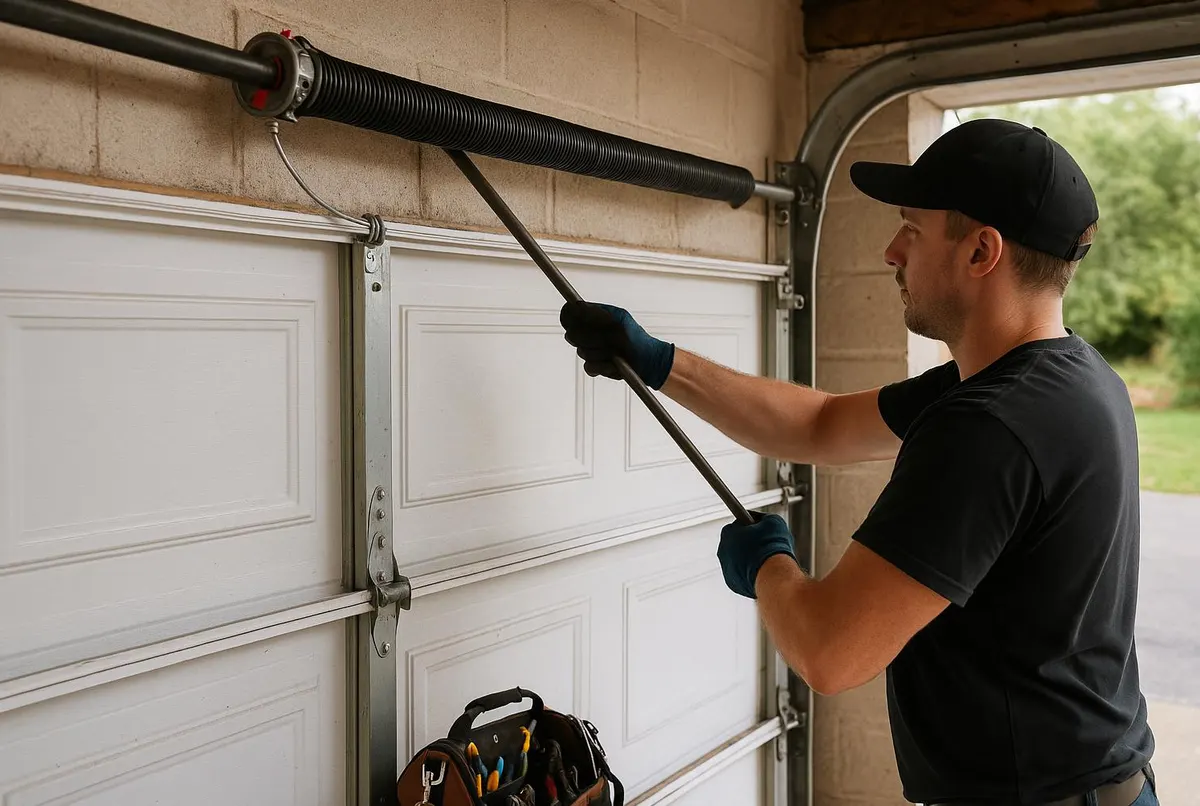
3. Broken torsion or extension springs
If the door was fine yesterday and today it's dead weight, a spring has likely snapped. You may have heard a loud bang, often mistaken for a gunshot. Springs do the heavy lifting on a garage door, and once one fails, the opener isn't strong enough to lift the door on its own, so it just strains or stalls. Spring repair means replacing the spring under tension with the correct wire gauge and length, a job that requires specialized bars and should not be attempted without the right tools. Salt air near the coast accelerates spring corrosion, so homes closer to the water tend to see failures sooner than inland properties.
4. Cables off the drum or frayed
The cables that run alongside the springs can slip off their drums or fray from rust, especially in salt-exposed areas. A door with a loose cable often hangs crooked or drops suddenly on one side. Repair involves re-winding the cable onto the drum under controlled tension or replacing a frayed cable outright.
5. Off-track rollers or a bent track
If the door jumped the track, often from an impact, a bent bracket, or wind pressure during a storm, you'll see a visible gap between the roller and track or hear grinding. The track needs to be realigned or replaced, and any bent sections usually get swapped rather than bent back, since a weakened track won't hold up under wind load.
6. Trolley disconnected from the opener arm
Every opener has an emergency release cord, the red handle hanging from the trolley. If it's been pulled, accidentally or during a power outage, the opener will run but the door won't move because it's no longer connected. Reconnecting it is simple: pull the carriage back into the track until it clicks into place.
7. Stripped gear or worn opener motor
Opener gears, usually a nylon or plastic drive gear, wear out over time and can strip completely, especially on older units that have been running in a hot, humid garage for years. A stripped gear sounds like the motor is running with no resistance and no door movement. This requires opening the opener housing and replacing the gear kit, or replacing the opener if it's old enough that parts are hard to source.
8. Swollen or warped panels binding the track
Wood and composite panels can absorb moisture during humid stretches and swell just enough to bind against the track, especially after a run of afternoon downpours. The door looks fine but fights the track on the way up. Panel replacement or adjustment, plus better garage ventilation, usually solves it for good.
When to call St. Joseph Garage Door
If you've checked the power, the remote, and the sensors and the door still won't move, stop trying to force it, especially if a spring or cable is involved. Those parts are under heavy tension and are not safe to handle without training. St. Joseph Garage Door handles Garage Door Spring Repair and Garage Door Cable Repair as same-day calls throughout Gulf County, and we also run Garage Door Tune-Up & Maintenance visits that catch rust, worn rollers, and loose hardware before they turn into a dead door during a storm.
If your garage door in St. Joseph, Port St. Joe, Wewahitchka, or anywhere nearby won't open, call St. Joseph Garage Door. We'll diagnose it on the spot and get it moving safely, the same day whenever possible.